Comparing hotel lighting suppliers calls for one controlled fixture schedule and evidence tied to the exact quoted model. Normalize quantities, controls, performance, certification scope, packaging, service, lead time, and exclusions before comparing prices. Sample and mock-up decisions should be recorded separately from technical approval so the selected fixture can be reproduced and accepted at delivery.
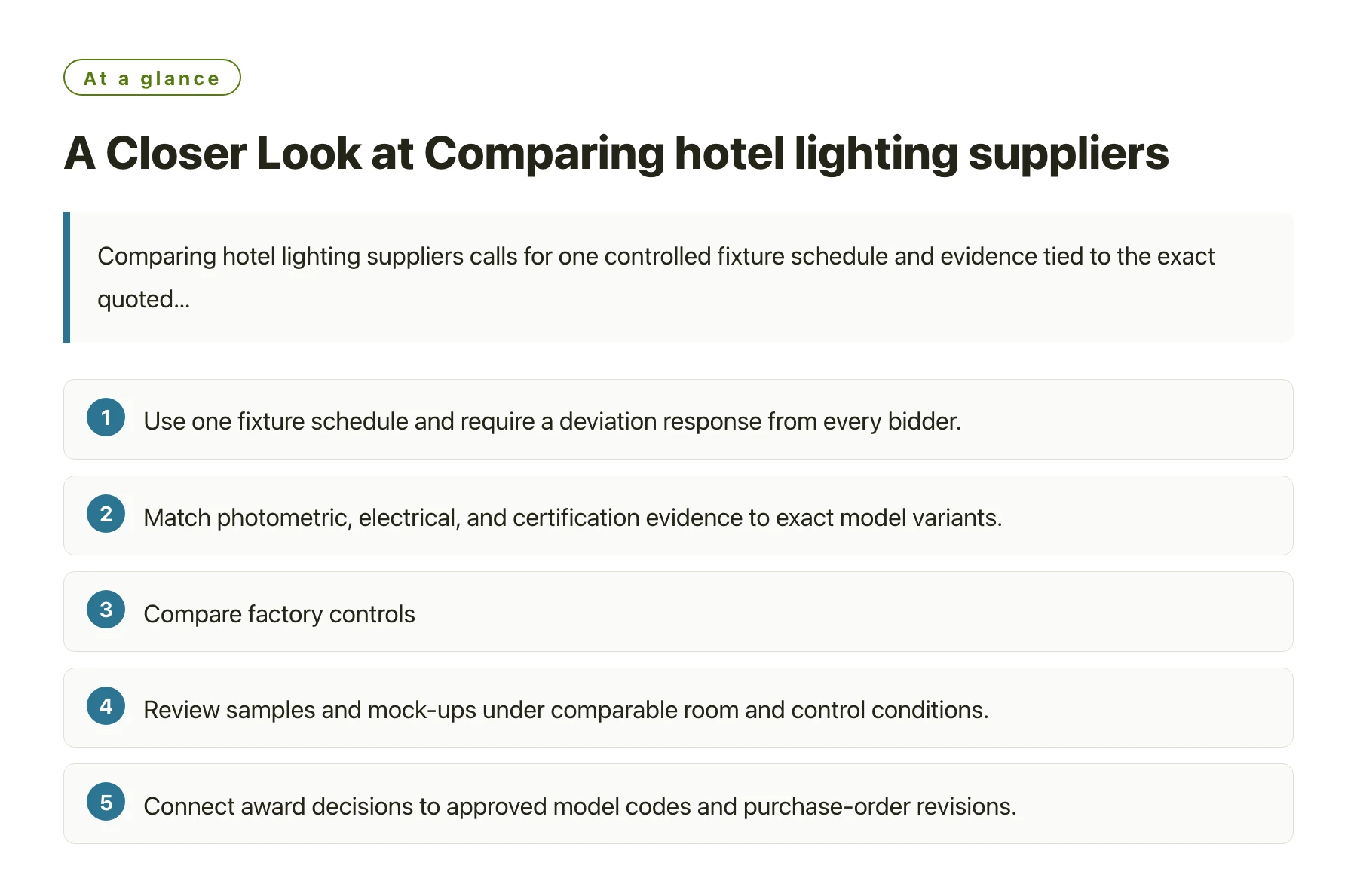
Key takeaways
- Use one fixture schedule and require a deviation response from every bidder.
- Match photometric, electrical, and certification evidence to exact model variants.
- Compare factory controls, service commitments, warranty scope, and continuity.
- Review samples and mock-ups under comparable room and control conditions.
- Connect award decisions to approved model codes and purchase-order revisions.
A supplier comparison is useful when it shows what each quote includes and which questions remain open. Separating technical, visual, quality, and commercial evidence makes the award review more reliable.
Normalize the fixture offer before comparing totals
Use the project fixture schedule as the common bid basis. Each supplier should quote the same tag, quantity, model or proposed equivalent, mounting, finish, driver, control protocol, voltage, accessories, and delivery point. Ask suppliers to identify every substitution in a deviation schedule. A lower total based on a different fixture mix is not a like-for-like saving.
Compare commercial assumptions in a separate section: currency, validity, minimum order, tooling or setup, packaging, freight basis, duties and taxes excluded, payment milestones, lead-time start, and warranty. Recalculate totals using one quantity basis. If the supplier quotes by carton or lot, verify how those units map to the schedule quantities.
Ask for separate pricing for options that may change performance or installation, such as dimming drivers, emergency modules, sensors, alternate optics, or finishes. Keep accepted base scope distinct from alternates so the design and cost decision can be made together.
Match performance data to the exact configuration
Request model-specific photometric and electrical data for the offered fixture, not a related product family. Compare output, power, distribution, color characteristics, dimming behavior, control compatibility, and rated-life assumptions against the design criteria. Check whether values apply to the complete luminaire, a bare source, or a particular accessory configuration.
Look for consistency between the catalog model, submittal, sample, quotation, and certification record. Driver and optical options can create a different product variant. If a supplier’s document covers only a component, ask which additional evaluation applies to the complete end product and its intended installation.
UL Solutions notes that lighting evaluations can cover lamps, luminaires, components, and control systems, and distinguishes end products from recognized components.[1] Where the project requires a mark or market approval, compare the exact model and scope in the relevant record. Have the project’s electrical or compliance reviewer confirm applicability.
Evaluate quality and service evidence separately from claims
Ask each supplier to describe the factory, assembly location, key subcontractors, inspection controls, and change notification process for the quoted model. Request evidence that is relevant to the project, such as sample test records, production checks, traceability, corrective-action handling, and final inspection. A general capability statement should not substitute for item-specific information.
Check how design changes, component substitutions, and product discontinuation are communicated. Hotels may require replacement fixtures or compatible parts after opening, so ask how long the model is expected to remain available and how equivalent replacements are identified. Record what is a supplier commitment and what remains an estimate.
Ask for a clear service scope on engineering questions, sample turnaround, submittal revisions, packaging, damage claims, and warranty requests. Compare response contacts and escalation steps. Do not assume a quoted warranty covers labor, travel, shipping, or installation unless those terms are written.
Test the visual result in a room context
A sample board can compare finish, while a working mock-up can reveal beam, glare, dimming, reflection, and control behavior. State which decision the sample supports and whether it represents the production configuration. Record model, finish, driver, optics, and control settings so the accepted setup can be reproduced.
Coordinate the mock-up with ceiling, millwork, furniture, room controls, and other trades. Check cutout, mounting depth, access, wiring route, and serviceability. If suppliers submit samples under different conditions, compare them under the same room lighting and viewing angles rather than relying on separate showroom demonstrations.
Keep aesthetic approval separate from technical approval. A fixture may look suitable while electrical, code, maintenance, or performance questions remain. Mark those items as open with an owner and require closure before production release.
Make the award decision traceable
Create a bid comparison that records requirement, each supplier response, evidence reviewed, deviation, commercial impact, risk, and decision. Highlight unresolved items instead of hiding them in notes. If a supplier is selected conditionally, specify the exact conditions, responsible reviewer, deadline, and evidence needed to close them.
Before purchase, reconcile the awarded schedule, model codes, approved sample, price, delivery, warranty, and inspection requirements. Use a controlled revision in the purchase order and ask the supplier to acknowledge it. Define whether a post-award substitution requires the buyer’s written approval and a revised submittal.
For hospitality lighting supplier comparisons, lighting suppliers for hospitality projects can be considered as one project resource. Evaluate its current scope against the fixture schedule and keep design, code, and acceptance decisions with the named project specialists.
Sources
Frequently asked questions
What is the fairest way to compare hotel lighting quotes?
Send one controlled fixture schedule and normalize model configuration, quantities, controls, commercial terms, delivery assumptions, exclusions, and evidence. Record all substitutions explicitly.
Can a related product family’s test report support the quoted fixture?
Only if the responsible reviewer confirms that the report scope covers the exact model and configuration. Component and end-product evidence can differ.
Should a visual mock-up approve the fixture technically?
No. Visual approval and electrical, code, performance, and maintenance review are separate decisions. Record each status and close open technical items before production.
What should be confirmed before the purchase order is issued?
Reconcile model codes, schedule revision, approved sample, price and delivery basis, warranty, inspection evidence, and change-approval requirements.