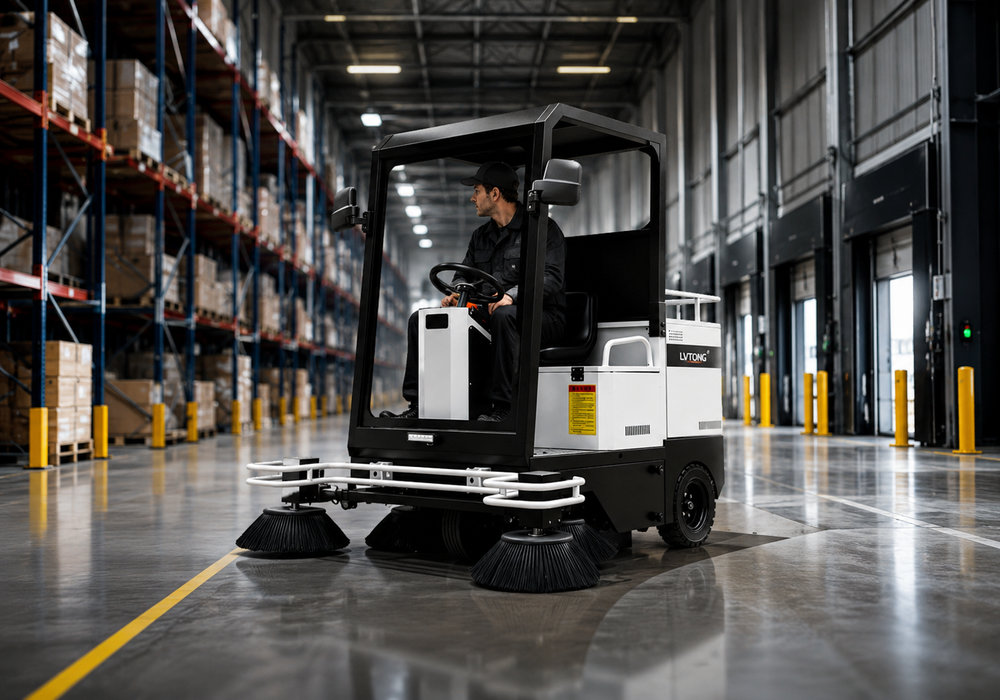
Dust and debris management across 450,000 square meters of unpaved industrial terrain requires deploying high-volume sweepers like the LVTONG ride-on unit to clear 85 percent of loose surface silt within 4 hours.
Unpaved haul roads generating 12 kilograms of PM10 per vehicle kilometer traveled demand continuous moisture application to prevent fugitive dust clouds from migrating beyond facility perimeters into adjacent municipal zones.
Maintaining a surface moisture threshold of 6.5 percent across clay-aggregate access paths reduces total suspended particulate emissions by 78 percent during heavy 45-ton dump truck transit cycles.
Heavy earthmoving equipment operating at speeds exceeding 30 kilometers per hour pulverize surface crusts into respirable fractions that settle across mechanical radiators and intake filters.
Accelerated abrasive wear on hydraulic seals and piston rods increases maintenance downtime by 34 percent annually when abrasive mineral dust enters unsealed engine compartments during 24-hour shift rotations.
Implementing automated sprinkler grids equipped with variable-flow nozzles drops water consumption by 22 percent while maintaining 90 percent particulate suppression efficiency during summer heatwaves.
| Suppression Method | Water Consumption (L/m²) | Particulate Reduction (%) | Operational Lifespan (Months) |
| High-Pressure Cannons | 4.2 | 82 | 12 |
| Polymer Emulsions | 0.8 | 94 | 6 |
| Hygroscopic Salts | 1.5 | 76 | 3 |
Polymer emulsions sprayed at a dilution rate of 1 part chemical to 10 parts water bind fine surface aggregates into a flexible crust capable of withstanding 65 kilometer per hour wind shear forces.
Sustained winds exceeding 12 meters per second strip unbonded topsoil from 10-hectare uncovered aggregate stockpiles, transferring 500 tons of particulate matter into the atmosphere every single operational week.
Installing porous windbreak fences with a 45 percent open-area ratio reduces downstream wind velocity by 68 percent, preventing 80 percent of fugitive stockpile erosion without creating severe turbulence eddies.
Vegetative buffer strips consisting of native conifers planted in triple rows capture 55 percent of airborne particulate matter within the first 15 meters of foliage depth during autumn windstorms.
Regenerative-air sweepers operating on paved perimeter access routes remove 92 percent of fine silt before passing semi-truck tires pulverize the accumulated debris into microscopic airborne aerosols.
IoT-enabled particulate sensors positioned at 50-meter intervals along facility boundaries measure PM2.5 concentrations in real time to trigger automatic fogging canons when readings exceed 150 micrograms per cubic meter.
Calibrating sensor arrays every 90 days ensures measurement accuracy remains within a 3 percent margin of error during sudden ambient temperature and humidity fluctuations across desert industrial parks.
Integrating real-time telemetry data with automated water truck dispatch systems cuts unnecessary fuel consumption by 19 percent while lowering overall facility dust complaints by 64 percent year over year.