How to Write Prompts for Better AI Sex Chat
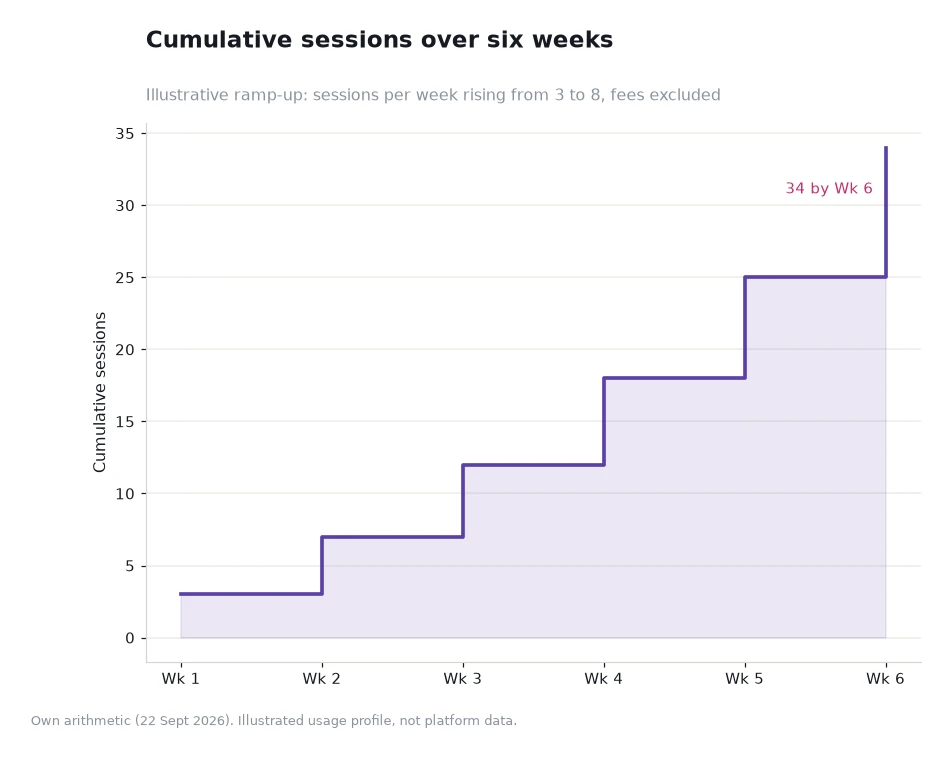
A prompt is not a wish; it is a brief. Three parts do almost all of the work — context, constraints and direction — and a fourth habit, leaving things out, does the rest. The returns compound quickly: on the illustrative six-week profile charted below, cumulative sessions reach 34 by the final week, and the quality of what happens inside those sessions depends on roughly two lines of setup per thread.

Key takeaways
- Context names the situation, constraints name the register, and direction states what should happen next.
- Two sentences of setup per thread is usually enough; past that, added words compete with each other instead of clarifying.
- Rewrite, do not append. A five-line correction bolted onto a four-line prompt leaves five contradictory instructions in play.
- Copy the wording that works. The platform's own phrasing, such as Sex AI companions and adaptive replies, describes behaviour you can ask for by name.
The three parts of a prompt
Context answers where and who. One sentence setting a place, a relationship and a moment is more useful than a paragraph of history, because it gives the reply something specific to attach to. Context is the part most people skip, and its absence is the main reason replies drift toward generalities.
Constraints answer how. This is where register lives: measured rather than blunt, teasing rather than earnest, slow rather than immediate. Constraints are also where you set what should not happen, and phrasing them positively usually works better than a list of prohibitions, because a positive constraint gives the reply a target rather than a wall.
Direction answers what now. A prompt should end with an action, a question or an open decision, so the reply has somewhere to go. Direction is what turns a description into a scene with momentum, and it is the part worth spending your second sentence on if you only have two.
What to leave out
The two habits that degrade a prompt most are accumulation and contradiction. Accumulation is appending a new line every time something goes wrong: after four rounds the prompt contains four corrections that describe four different conversations. Contradiction is stacking adjectives that cancel each other, such as asking for something both reserved and uninhibited in the same breath.
Length is the third trap. A long prompt is not a thorough prompt; it is a prompt where the important instruction is harder to find. If an exchange is not working, the faster fix is to rewrite the setup in two sentences rather than to add a third and a fourth.
What separates an instruction that lands from one that evaporates is usually the verb. "Be more present" asks the reply to guess. "Answer in two sentences and end with a question about the room" asks for something countable. When a thread stalls, the quickest diagnosis is to find the vaguest verb in your last message and swap it for one describing an observable action — which is why most prompts improve on the second attempt rather than the fifth.
| Element | Weak version | Stronger version |
|---|---|---|
| Context | Asks for a mood with no place or relationship | One sentence naming place, relationship and moment |
| Constraint | A list of things that must not happen | A positive register to hold, such as measured and unhurried |
| Direction | Ends with a description and no action | Ends with a question, an action or a decision to make |
| Corrections | A fifth line appended to a four-line prompt | The setup rewritten in two lines |
| Wording | Invented vocabulary for platform behaviour | The platform's own terms, such as adaptive replies |
Worked example
Prompt quality shows up in how long a thread survives, so it helps to have a rough model of thread growth. The illustration below is arithmetic built for this article, not platform data. Cumulative sessions run 3, 7, 12, 18, 25 and 34 across six weeks. The weekly additions behind those totals are 3, 4, 5, 6, 7 and 9.
Check the line: after week one, 3 sessions. Week two adds 4, giving 3 + 4 = 7. Week three adds 5: 7 + 5 = 12. Week four adds 6: 12 + 6 = 18. Week five adds 7: 18 + 7 = 25. Week six adds 9: 25 + 9 = 34. The chart's subtitle describes a ramp-up from roughly 3 sessions a week towards 8, and the final week's 9 is what pushes the cumulative line to 34.
Now attach an assumption about setup. If each session opens with two sentences of context and constraints, six weeks at an average of five sessions covers about 30 sessions and 60 sentences of setup — under fifteen minutes of writing across six weeks. The cost is trivial, and the effect is that no thread restarts cold.
Where prompt craft pays off fastest
The gain is largest at the boundary between a listing you like and one that suits you. Prompts do not change what a listing is built for, so time spent rewriting is best spent on listings that already sit close to your register — the character search view is the quickest way to widen that shortlist. Two experiments, run in parallel and each kept to two sessions, will tell you more than a week of tinkering with one.
A second discipline is to change one variable at a time. If a session opens with fresh context and fresh constraints together, the result tells you nothing about which change helped. Alternate instead: context in one run, constraints in the next, direction in the third, with the listing held fixed. Three runs of one session each is a small budget, and it yields a setup you can trust rather than one that happened to work once.
The platform's own description of its behaviour is a reliable source of vocabulary for this. It states that replies adapt to your personality and remember your preferences, and that characters recall previous interactions and adapt over time. Those are the properties to lean on: state a preference clearly once, let the memory keep it, and use later prompts to add situations rather than to repeat instructions. Treated as sex ai deliberately — a writing exercise rather than a lottery — the payoff usually arrives in the second week, once a setup has been revised twice.
Keep a short note of what worked. Three lines per listing, written after the session, is enough to rebuild the setup months later — which matters, because the prompt that produced a good thread is the only record of why it worked.
Frequently asked questions
How long should a prompt be?
Two sentences for the setup, one for direction. Anything longer tends to bury the instruction that matters rather than reinforce it.
Should I correct a reply I do not like?
Yes, but rewrite instead of appending. Rewriting keeps one coherent description in play; appending leaves the old instruction active beside the new one.
Do prompts change what a listing is designed for?
No. Prompt craft improves the fit between you and a suitable listing. Picking by tag and description is still the first decision.
Treat the prompt as a brief
Write the setup in two lines, end on a direction, and rewrite rather than accumulate. Those three habits cover most of what separates a thread that holds from one that fades by the third exchange.
The second habit is measurement in weeks rather than minutes: keep the listing, keep the setup, and see whether the pattern still works on a return visit. This piece is written for adults 18 and over.
Data and sources: platform wording for adaptive replies and remembered preferences, plus trend counters, read from the Crushon pages on 22 Sept 2026[1]. The six-week session profile and the 60-sentence estimate are illustrative assumptions, not platform data. For adult readers (18+) only.