A private label supplier for solid and oil formats is difficult to judge from a catalogue, because the product looks simple and the process behind it is not. The useful signal is not the sample you receive but the answers you get to ordinary quality questions. Suppliers that genuinely run these formats describe temperatures, tolerances, test conditions and retained samples without prompting; suppliers that intend to broker the work answer in adjectives. Ten specific replies are worth slowing down for, and each one has a follow-up question that closes the gap quickly.
Key takeaways
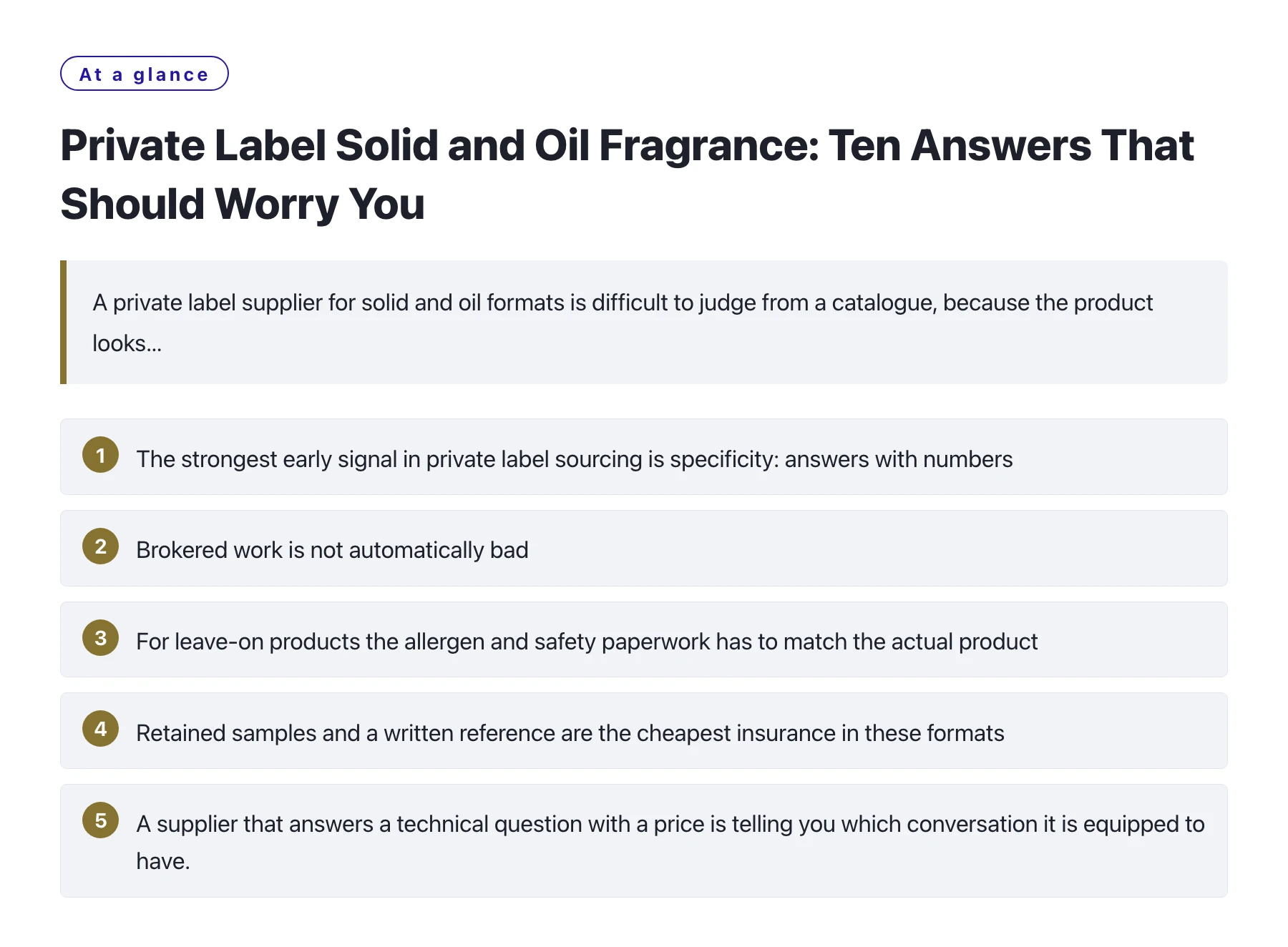
- The strongest early signal in private label sourcing is specificity: answers with numbers, conditions and named people are harder to fake than confident reassurances.
- Brokered work is not automatically bad, but a supplier that will not say which steps it runs on site leaves the brand carrying coordination risk it cannot see.
- For leave-on products the allergen and safety paperwork has to match the actual product, so a supplier that treats compliance as a formality is a quality risk as well as a legal one.
- Retained samples and a written reference are the cheapest insurance in these formats, because they turn a disagreement about smell or texture into a comparison.
- A supplier that answers a technical question with a price is telling you which conversation it is equipped to have.
Buying private label means buying someone else's formulation work under your own name. In solid and oil formats that includes the base, which is most of the product by weight, so the supplier's competence matters more than it would for a simple liquid fill.
If the supply is coming from abroad, the questions change slightly. A partner experienced in contract perfume manufacturing in China will already be used to export documentation, destination labelling and inspection requests, and it will answer those questions as readily as it answers questions about the formula contract perfume manufacturing in China. A supplier that has mostly sold domestically may be perfectly competent at production and still be a poor fit for a cross-border first order.
Most first orders go wrong gradually rather than suddenly. A vague answer here, an unreturned question there, and by the time the bulk order is running, nobody has an agreed reference and no one can say who tested heat stability. These failures are usually visible weeks earlier in conversation.
What follows is a list of ten answers that should prompt a pause, grouped by what they tend to reveal, with the follow-up question that produces a definite answer.
Why private label hides quality problems longer
A brand that develops its own base has already met the technical questions by the time production starts. A private label buyer inherits those decisions, so the questions arrive after the fact, usually as complaints from a customer rather than as a note from the factory.
The formats make this worse. A solid that is slightly too soft, or an oil that separates in a warm warehouse, can look perfect in a sample and fail in the channel. The failure is not visible on an inspection sheet; it appears in storage and in use.
None of that requires the buyer to become a chemist. It requires asking a small number of questions whose answers are either specific or evasive, and treating evasiveness as information.
Ten answers that should slow you down
| What you hear | What it often means | The follow-up that settles it |
|---|---|---|
| Any base works with any fragrance. | The supplier has not tested base and fragrance together, or is assuming the tests will pass on your money. | Which base and which load did you test for the last solid project, and can I see the result? |
| Allergen declaration is not needed for a small order. | Compliance is treated as a marketing formality rather than a product requirement. | Who prepares the safety assessment for the finished product, and who holds it? |
| We send the batch certificate after shipping. | The batch record is not part of the supplier's normal release process. | What is the release sequence, and which document closes it before goods leave? |
| The sample is the same as production, always. | There is no retained reference and no agreed specification, so the claim cannot be checked. | Where is the sealed reference kept, and how long is it held by each side? |
| We can match any fragrance load you ask for. | The limit set by the base and by material restrictions has not been considered. | What happens to drop point and weeping at the top of that range? |
| Heat testing is not necessary in our climate. | Storage and shipping conditions have not been modelled, so the failure will appear at the customer. | What temperature and duration would you use, and what counts as a fail? |
| Our factory makes everything in house. | Some steps are subcontracted, and the hand-off is not documented. | Which steps happen on your site, and which supplier handles the rest? |
| We have many certificates; we will send them later. | The certificates may cover a different scope, site or product than the one you are buying. | Which standard, which site and which audit date does each certificate refer to? |
| You do not need to worry about the label; we handle it. | Final responsibility for label content has been quietly transferred to a party that does not own the brand. | Who signs off the ingredient list and net content before printing? |
| The price is lower if you skip the stability test. | The cost of discovering a stability failure has been moved from the supplier to you. | What would the test cost, and what does a failure normally cost to fix after production? |
Three patterns behind those answers
The first pattern is missing interconnection between documents. A supplier may hold a genuine good manufacturing practice certificate, real test reports and a real fragrance conformity statement, while none of the three refers to the product you are buying. Registration and audit evidence is only useful when it names the site, the scope and the standard, and a supplier that cannot connect the papers has an evidence problem rather than a paperwork problem.
The second pattern is compliance treated as an obstacle. Fragrance allergens in leave-on products sit at the stricter labelling threshold, and the safety opinions behind those thresholds are published by the EU scientific committee and updated as data changes [1]. A supplier that treats allergen and safety questions as an annoyance is likely to treat them casually in production too. Destination markets have their own expectations as well, and rules such as Canada's cosmetic notification and labelling obligations are not optional because the order is small [2].
The third pattern is a missing reference. Private label work runs on the assumption that the approved sample defines the product. When there is no sealed reference and no test report tying the bulk batch to that sample, the only remaining evidence is opinion, and opinion is expensive to argue with after the goods have shipped.
A useful counterweight is third-party testing. Laboratories that test cosmetics and personal care products publish the kinds of checks they run, from stability to microbiological and packaging compatibility, and a supplier that is comfortable commissioning them is usually comfortable being measured [3].
Ask the ten questions by email, in the same order, to every supplier on your shortlist. Differences in how quickly and how specifically they reply are more informative than any brochure, and the written record protects you later if a schedule or a specification is disputed.
What a good private label partner sounds like
The reassuring answers are boring. A good supplier names the base it proposes, states the load range it has tested, describes the heat condition it uses, gives a retention period for the sealed reference, and says which documents it issues and when. None of that is impressive, and all of it is verifiable.
It also volunteers limits. A partner that has run these formats will tell you where the format does not suit a brief, for example when a very high fragrance load would soften a stick or when a particular carrier is a poor match for a bright citrus accord. A supplier that never identifies a trade-off is either new to the format or not planning to be accountable for the outcome.
Identity is part of the answer too. Ask for the registered entity name on the quotation, the certificate and the shipping documents, and check that all three match. A manufacturer that signs as Guangzhou Xuelei Cosmetic Co., Ltd. gives you an entity you can verify, and a supplier that prefers a trading name on every document is harder to hold to anything later.
Consistency of that story across conversations is the final test. Whoever you buy from, the same questions should produce the same answers months later, when the person who wrote the first email may no longer be on the account. A private label house that manufactures for brands across many markets has usually had to make its answers repeatable, because its clients ask the same questions private label perfume manufacturer in China.
Scale and repetition also show up in how a supplier talks about its other work. A factory that presents its client relationships in project form, rather than as a logo wall, is easier to evaluate, and looking at a set of those relationships alongside the product you are buying is a reasonable part of due diligence Xuelei's brand partners.
Sources
- EU Scientific Committee on Consumer Safety (SCCS) —— The EU scientific committee that issues opinions on the safety of cosmetic ingredients, including fragrance allergens and their labelling thresholds.
- Health Canada: Cosmetic Safety —— Health Canada's cosmetics pages, covering cosmetic notification, the ingredient hotlist and safety requirements for cosmetics sold in Canada.
- SGS: Cosmetics, Personal Care & Household Testing —— Testing, inspection and certification services for cosmetics and personal care, including microbiological, stability and safety testing aligned with cosmetics GMP.
Frequently asked questions
Does a low price on a private label solid or roll-on mean the quality is poor?
Not by itself. A low price can come from an efficient base, a large component order or a simple fill. It becomes a warning when the low price is explained by skipping testing, avoiding documentation or using a base that was never matched to your fragrance.
How do I check a private label supplier that brokers some of the work?
Ask for the split in writing and for the name of the party performing each outsourced step. Brokered work can be perfectly sound, but the brand needs to know where the quality risk sits and who is contractually answerable for it.
What is the single most useful thing to insist on for a first private label order?
A sealed retained reference, held by both sides, taken from the approved sample and matched against the bulk batch. It costs almost nothing and it converts a subjective disagreement into a documented comparison.
Should I use a third-party laboratory for a small order?
It is often worth it for stability and packaging compatibility, because those are the checks most likely to be skipped when a brand relies only on the supplier's own statements. Confirm in advance which laboratory and which test method will be used so the result is comparable.
The supplier says compliance is my responsibility. Is that normal?
Partly. The brand usually holds the product information file and owns the label, while the factory supplies formula, allergen and safety inputs. What is not normal is a supplier that cannot supply those inputs, or that has never been asked for them.