Sizing a Circuit for 53 TH/s and Up
A 53 TH/s miner at 20 joules per terahash pulls 1,060 watts, which is 4.42 amps on a 240 volt line and about a fifth of a 20 amp circuit. The same efficiency at 212 TH/s draws 17.67 amps, already past the 16 amp continuous limit of that breaker, and at 530 TH/s it needs 44.17 amps. The coins scale smoothly; the wiring does not.
Key takeaways
- 53 TH/s at 20 J/TH needs 4.42 A at 240 V; 530 TH/s needs 44.17 A, or three circuits rather than one.
- A 20 A breaker should carry no more than 16 A continuously, so 212 TH/s at 17.67 A already exceeds it.
- Each 53 TH/s step adds about 1,060 W, which is roughly the same as a small space heater left on all day.
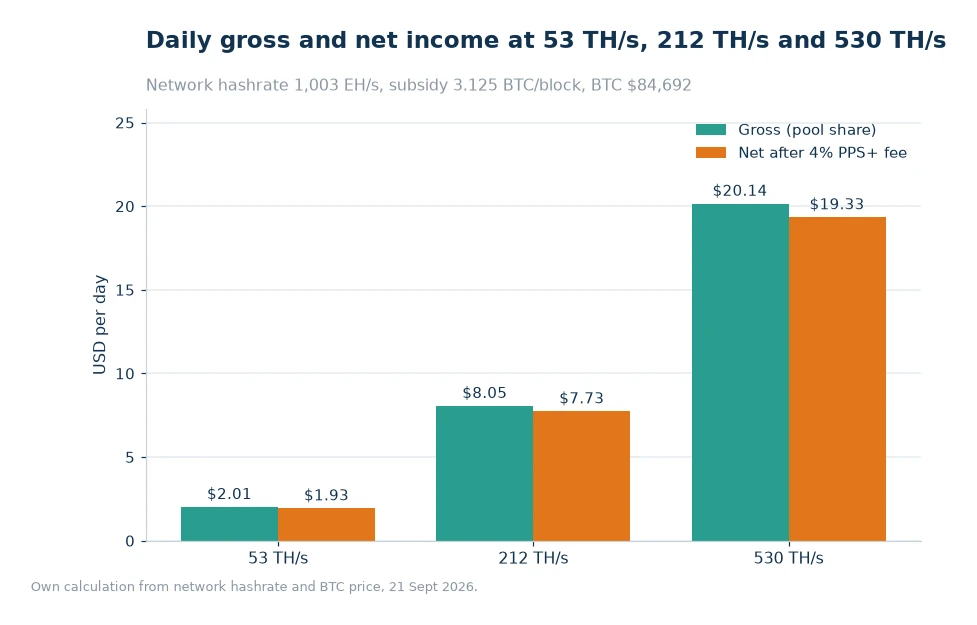
- The credit at 530 TH/s is $20.14 a day gross, but the electrician's bill arrives before the first coin does.
Amps, not coins, are the first constraint
Every mining plan starts with a hashrate target and then collides with a fusebox. The collision is arithmetic, and it is worth doing before the hardware order because it changes what can be installed where. Power in watts divided by volts gives amps, and amps are what the breaker, the cable and the socket are rated for.
European and many industrial supplies run at 230 to 240 volts, North American residential circuits at 120 volts for ordinary outlets and 240 volts for dryers, ovens and dedicated feeds. A miner on a 120 volt circuit needs twice the current for the same wattage, which is why most serious installations use a 240 volt feed even in houses that have both.
This is also the point where a cheap extension lead becomes a fire risk rather than a shortcut. A 1,060 watt load on a domestic socket is close to what a kettle draws, and a kettle runs for three minutes. A miner runs for three years. The connector, the cable and the breaker all age under that kind of duty, and the failure mode is not a blown fuse but a warm plug that nobody notices until it smells.
Three-phase supply changes the arithmetic without changing the physics. A 400 volt three-phase feed delivers the same power at a lower current per conductor, which is why industrial sites can run far more hashrate through cable that would be inadequate on a single-phase supply. For a home operator the practical version of this is simple: if the panel has spare capacity on two phases, spread the load rather than stacking every machine on one.
What 53 TH/s draws through a 240 V line
At 20 joules per terahash, 53 TH/s consumes 1,060 watts at the wall. Divide by 240 and the current is 4.42 amps. That is a comfortable load for a dedicated 16 amp circuit and a trivial one for a 32 amp feed, which is why small installations often start on a single circuit and grow until the panel objects.
The wall figure is higher than the board figure. A power supply is typically 90% efficient or a little better, so a machine whose chips draw 950 watts may pull 1,050 from the socket, and the difference leaves as heat in the room that the ventilation then has to remove. When a manufacturer quotes a power figure, treat it as an optimistic case and measure the real draw with a clamp meter before deciding what the circuit can take.
Accounts on ViaBTC Mining Pool do not care which circuit the machine is on, but the operator should. A pool credit that assumes continuous uptime is quietly wrong if a breaker trips every warm afternoon, and the fix is a load calculation rather than a support ticket.
The continuous-load rule and where it bites
Breakers are rated for intermittent load. For a load that runs for hours, the usual guidance is to keep it at 80% of the rating, so a 20 amp breaker carries 16 amps continuously and a 16 amp breaker carries 12.8. Mining is the definition of a continuous load, so the 80% figure is the one to design against.
That rule is what makes 212 TH/s awkward. At 17.67 amps it sits above the 16 amp continuous allowance of a 20 amp breaker, even though it is below the breaker's nominal rating. Running there may work for a while and then trip on a hot day, and a tripped breaker at three in the morning is a day of lost credit and a trip to the panel.
The alternative is a larger dedicated feed. At 530 TH/s the requirement is 44.17 amps, which means a 63 amp circuit or a three-phase supply, and that is an electrician's job rather than a shopping decision. Budget for the installation before the machines, because the lead time on a new feed is often longer than the lead time on the hardware.
Three loads against one 20 A circuit
The table converts each chart step into current at 240 volts and compares it with the 16 amp continuous allowance. Percentages are of the nominal 20 amp rating, so the middle row is the one that looks safe on paper and is not.
| Hashrate | Wall power | Current at 240 V | Share of 20 A | Verdict |
|---|---|---|---|---|
| 53 TH/s | 1,060 W | 4.42 A | 22% | Fits with room to spare |
| 212 TH/s | 4,240 W | 17.67 A | 88% | Above the 16 A allowance |
| 530 TH/s | 10,600 W | 44.17 A | 221% | Needs a dedicated feed |
A second consequence hides in the same numbers. Two 212 TH/s groups on separate 20 amp circuits are fine; two on the same circuit are not, and the panel schedule is the only reliable record of which is which. Label the breakers in permanent marker and photograph the panel, because the person who trips a circuit in a year will not remember which socket fed which rack.
Worked example
Take the top rung, 530 TH/s, and derive its current, its daily cost and the credit that has to cover it.
- Wall power: 530 × 20 = 10,600 W, or 10.6 kW.
- Current at 240 V: 10,600 ÷ 240 = 44.17 A.
- Continuous allowance: 44.17 ÷ 0.8 = 55.2 A, so a 63 A circuit is the smallest sensible fit.
- Daily energy: 10.6 kW × 24 = 254.4 kWh.
- Daily power cost at $0.06: 254.4 × 0.06 = $15.26.
- Daily credit: 0.00023776 BTC × 84,692 = $20.14 gross, or $19.33 after the listed 4% on the block-reward part.
- Difference: 19.33 − 15.26 = $4.07 a day, before cooling, rent and the cost of the electrical work.
- The same calculation at 53 TH/s gives 1.06 kW, 25.44 kWh, $1.53 of power and $1.93 settled, a gap of $0.40 a day.
Frequently asked questions
How many amps does 212 TH/s need at 240 volts?
At 20 joules per terahash the load is 4,240 W, which is 17.67 amps at 240 V, so it exceeds the 16 amp continuous allowance of a 20 amp breaker and needs a larger or additional circuit.
Can I run a miner on a normal household socket?
A 53 TH/s unit at 1,060 W is within the capacity of a dedicated 240 V circuit, but a continuous load on a shared domestic socket is a poor idea; use a dedicated feed and a clamp meter to confirm the real draw.
Does the pool care about the power supply?
No, the credit depends on submitted shares and current difficulty, but a supply that trips or throttles reduces uptime, and the daily figure of $19.33 at 530 TH/s assumes the machines keep running.
Label the panel before you energise
Draw the circuit before you buy the next machine: which breaker, which cable, which socket, which rack. Then measure the actual current with everything running, because a machine's rated draw and its measured draw are rarely the same number. The Mining Farms listings show what a properly provisioned site looks like, and the fee schedule tells you what the pool keeps once the power is safely delivered. Electrical work is the one part of mining that is cheaper to overbuild than to redo.
Sources: ViaBTC fee and farms pages[1]. Network inputs read 21 Sept 2026: 132.76 T difficulty, 1,003 EH/s hashrate, 144 daily blocks of 3.125 BTC, $84,692 per coin. Published 24 Oct 2026; 20 J/TH at the wall and a flat $0.06 tariff are assumed.